 Image 1 of 1
Dear neighbors,
I listened to an Atmos interview with Maggie Rogers a while back that I haven’t been able to get out of my mind. She was talking about the unrelenting production cycle of the music industry — the expectation to constantly churn out new stuff that I think many of us can relate to regardless of the sector we work in — and comparing it to the seasons. It is like we are in an endless spring/summer, and we never allow the fields to fall fallow — which is exactly what we need to regenerate our creative potential.
In my day job at Boston Food Forest Coalition, we are putting the gardens to bed so that the soil can restore itself for another season, which means burying it, returning shriveled vines and spent flower-heads to the earth. We are building little “bug snugs” (not unlike fairy houses) out of plant stalks for the pollinators to over-winter.
I find myself craving the perspective of those bugs. I want darkness. I want to dig a hole in the ground and whisper my secrets into it, like a character in Daniel Mason’s North Woods. I want to dig a pit in a field, like this woman I once saw on Instagram (I have trained my algorithm well), and lie down inside, looking up, listening to the red-tailed hawks circle overhead. Maybe it’s a seasonal affliction; maybe it’s just some sort of primal desire to crawl back into the womb as the clusterfuck of polycrises unfurls around us. I want rest; darkness offers a retreat.
But the dark isn’t only rest; it’s also where things come apart. Grief scholar and psychotherapist Francis Weller refers to our era of social and ecological breakdown as the Long Dark. The term is inspired by the “Nigredo” — or “the blackening” — from early alchemical traditions that believed a substance must be broken down to its most fundamental, darkest parts in order to transform into something new. In Jungian psychology, Nigredo became a metaphor for the process of confronting one’s inner darkness, allowing the disintegration of all the old beliefs and ego structures to make room for transformation.
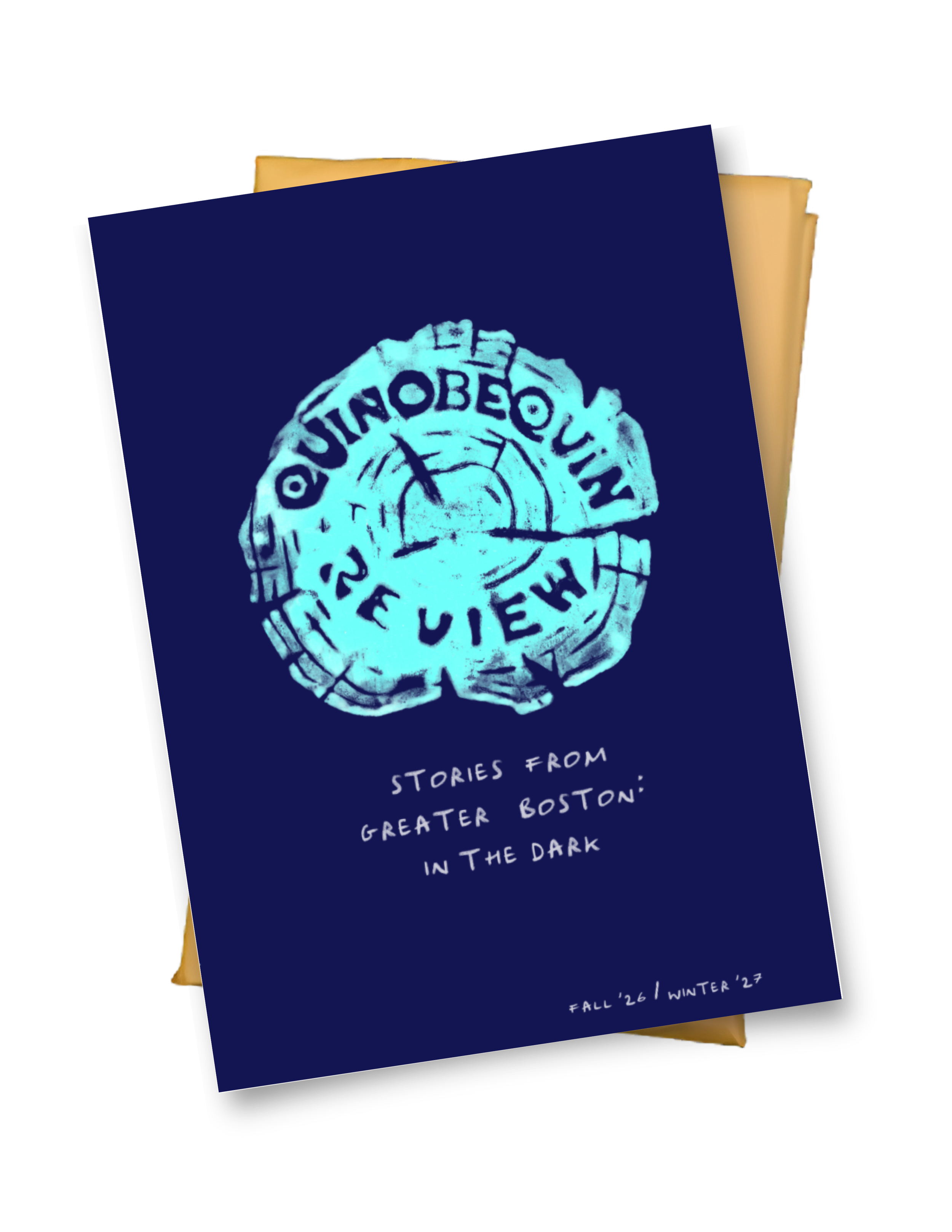
In the dark, we reinvent ourselves. You can find this impulse, the sense that we could become someone else under the cover of darkness, in an Allston basement (p. 28), a mosque (p. 58), and even a suburban cul-de-sac (p. 63). Darkness brings about what feels impossible in daylight, like flying turkeys (p. 14) and spectral visitors (p. 52). Darkness is simultaneously disorienting and reorienting (pp. 20, 66). It forces us to face loss (p. 30) and to invent new ways to make meaning (p. 81). Darkness, I hope, can also be a source of comfort. So snuggle up, turn off those overhead lights, and enjoy these stories from your neighbors as sustenance for the darker days of the year.
- AC